





OVERVIEW
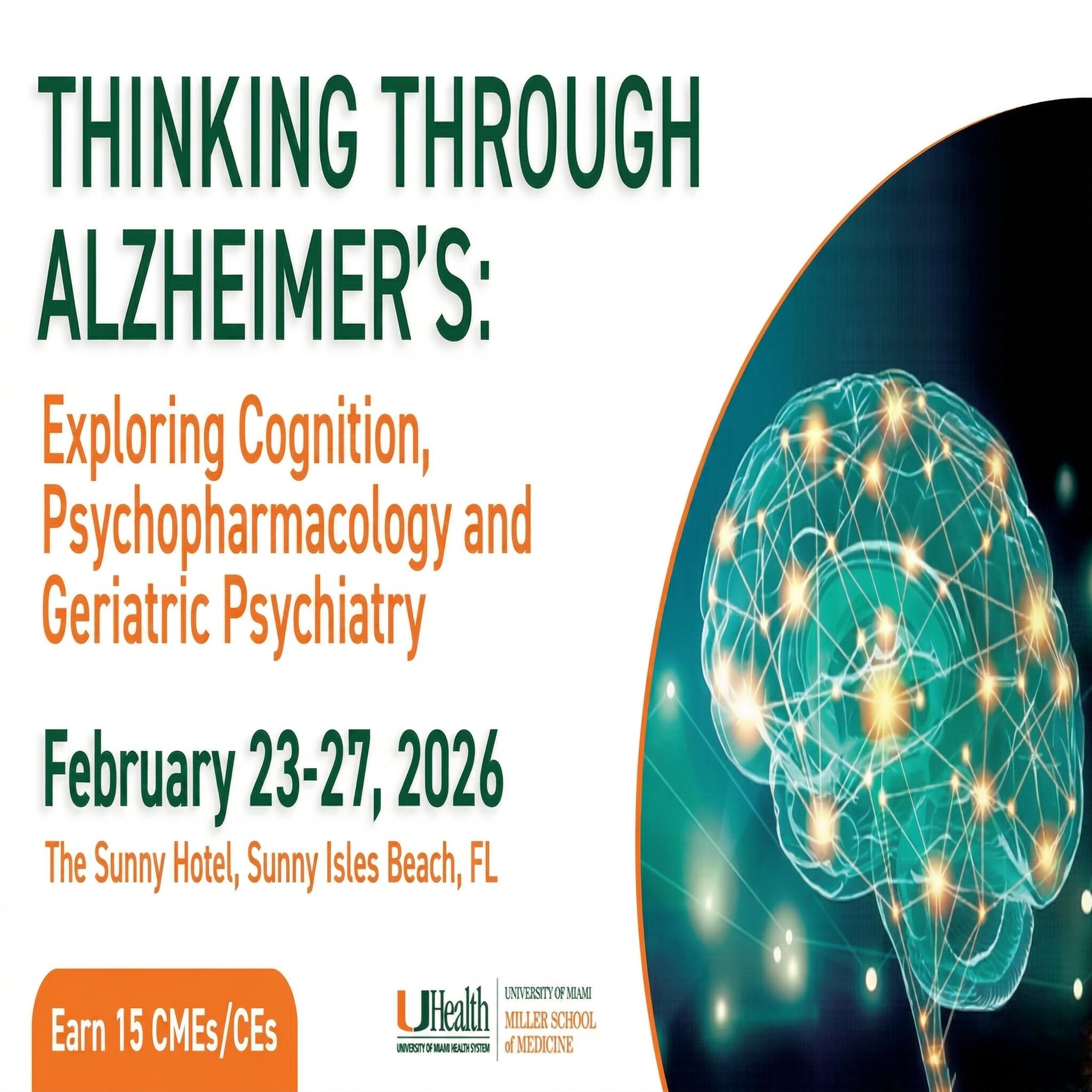
Thinking Through Alzheimer’s: Exploring Cognition, Psychopharmacology and Geriatric Psychiatry is organized by University of Miami Miller School of Medicine Division of Continuing Medical Education and will be held from Feb 23 – 27, 2026 at The Sunny Miami Sunny Isles Beach, Curio Collection by Hilton, Sunny Isles Beach, Florida, United States of America.
Description:
Brain health is recognized as an essential part of successful aging. To promote longevity and quality of life, optimal brain functioning across cognitive, social, emotional, and behavioral domains allows a person to realize their full potential over their lifetime.
Anxiety, depression and other mental health condition in later life can reduce longevity, increase the risk of medical and cognitive disorders and lead to poorer outcomes. Most concerning is the fact that the prevalence of cognitive disorders is increasing rapidly as people live longer. Reducing the risk of cognitive disorders such as Alzheimer’s Disease and Related Dementias (ADRD) is as essential to the clinician as reducing hypertension and diabetes in reducing cardiovascular disease.
This seminar is designed to educate the practitioners and equip them with essential knowledge and state-of-the-art scientific methods to diagnose Alzheimer’s Disease and Related Dementias (ADRD) at its earliest stages and assist patients and their loved ones. Understanding normal cognitive neurology and stradegies to reduce the risk of developing Alzheimer’s disease will also be discussed. Drawing on the presenters’ vast scientific and clinical expertise, the participants will be able to differentiate different cognitive syndromes and the etiological underpinnings of various clinical presentations. In addition, the participant will be familiarized with state-of-the-art neuropsychological and novel neuroimaging and plasma-based biomarkers methods to detect the earliest stages of Alzheimer’s Disease.
This presentation will also provide a comprehensive review of essential geriatric psychopharmacology in the treatment of the most common psychiatric and mental health conditions as well as the latest in emerging pharmacological agents in the treatment and management of Alzheimer’s Disease and its comorbid psychiatric and behavioral manifestations.
Objectives:
Upon completion of this activity, participants will be able to:
- Describe the promotion of brain health and longevity through evidence-based prevention.
- Differentiate between normal cognitive neurology, mild cognitive impairment (MCI), and clinical dementia.
- Demonstrate how to identify the underlying brain disorders causing clinical cognitive impairment in older adults.
- Identify the evidence-based, emerging brain biomarkers in cognitive disorders that help to diagnose at-risk older individuals for Alzheimer’s Disease and Related Dementias (ADRD).
- Identify the role of traditional and novel cognitive neuropsychological testing in early diagnosis of cognitive disorders in older individuals.
- Differentiate Alzheimer’s Disease from non- Alzheimer’s Disease pathology
- Describe current pharmacological and nonpharmacological approaches to the treatment of Alzheimer’s Disease and Related Dementias (ADRD).
- Identify the emerging and promising agents in the treatment and management of early Alzheimer’s disease (AD).
- Recognize geriatric psychopharmacology and how to optimally treat the more challenging geriatric mental health conditions.
SPECIALITIES
NeurologyPharmacologyGeriatricsPsychiatry
thinking Through Alzheimer’s 2026 – Video List
| SR No | Title | Runtime |
|---|---|---|
| 1 | Alzheimer’s and Pre-Alzheimer’s: Emerging Biomarkers | 65:52 |
| 2 | Advances in Cognitive Neuropsychological Assessment | 35:52 |
| 3 | Alzheimer Disease and Related Dementias: Integrating Pharmacologic and Nonpharmacologic Management | 48:04 |
| 4 | Alzheimer Disease Management: The Newest Therapeutic Strategies and Treatment Considerations | 48:46 |
| 5 | Dementia Care: Managing Caregiver Burden and Family Dynamics | 49:42 |
| 6 | Psychopharmacology in Older Adults: Managing Drug Interactions and Adverse Effects | 48:17 |
| 7 | Amnestic Mild Cognitive Impairment: Identifying Patients at High Risk for Progression | 47:20 |
| 8 | Dementia Subtypes: Key Diagnostic Distinctions in Clinical Practice | 43:29 |
| 9 | Alzheimer Disease Risk Reduction: Strategies to Delay Cognitive Decline | 55:49 |
| 10 | Normal Aging and Cognition: Maintaining Cognitive Health in Older Adults | 50:30 |

Reviews
There are no reviews yet.